
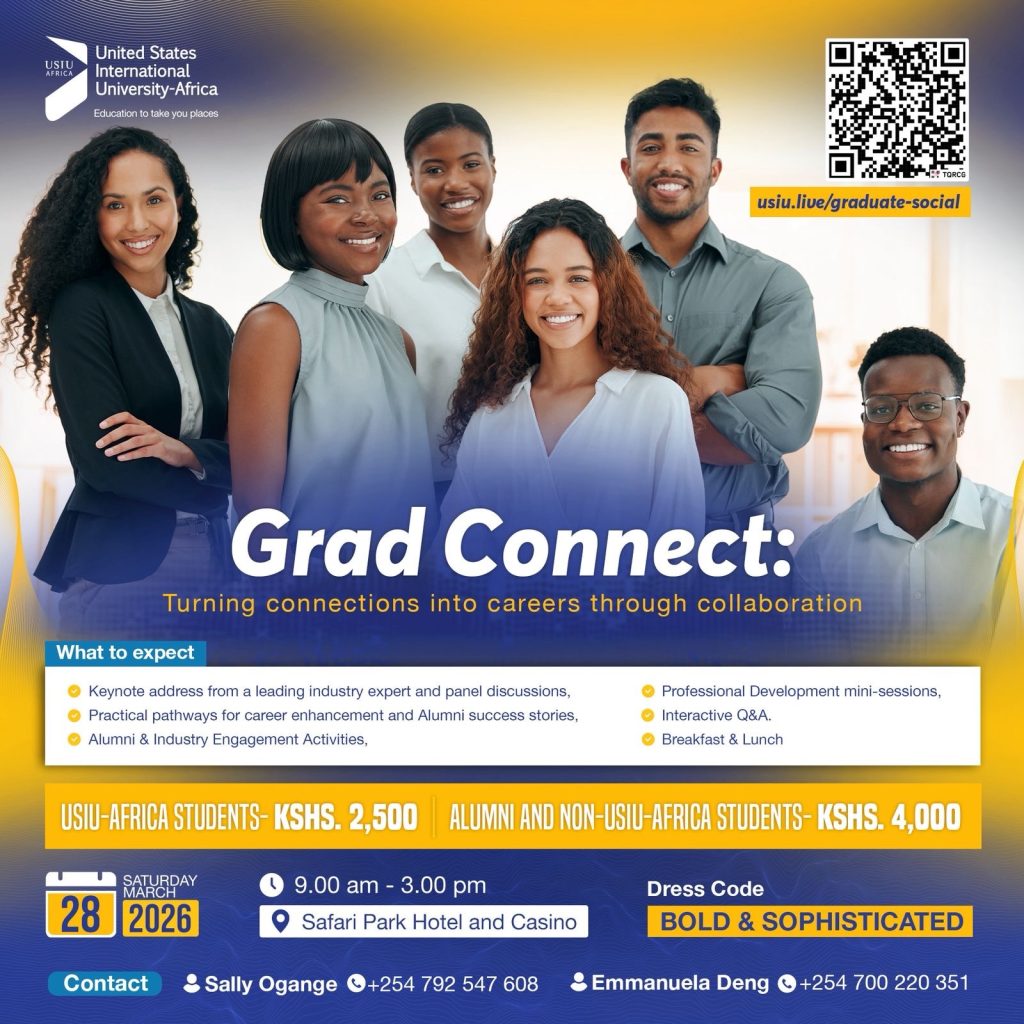
Nairobi, Kenya – March 28, 2026
The United States International University-Africa Graduate School convened students, alumni, industry leaders, and development partners at the Safari Park Hotel for the 2nd Edition of Grad Connect 2026, a flagship networking forum aimed at transforming academic research into real-world solutions.
Held under the theme “Connections to Impact: Turning Research into Real-World Solutions,” the event built on the success of its inaugural edition in 2025, deepening collaboration between academia and industry while strengthening pathways for career growth and innovation.
In his opening remarks, Vice Chancellor Mwenda Ntarangwi underscored the importance of building meaningful connections beyond academic credentials. He challenged participants to rethink networking as a long-term investment rather than a transactional exercise.
“Take time to build relationships. Don’t rush to ask for opportunities—be genuinely interested in people first. The strongest connections are built on shared human experiences, not just professional titles,” he said.
The event featured a distinguished keynote address by Paul Kasimu, who delivered a thought-provoking session on the future of work and the skills required to thrive in an evolving global landscape.
Kasimu emphasized that the world is transitioning rapidly through technological and societal shifts, urging students to position themselves for relevance in what he described as a disruptive era.
“We are living in a world where change is constant and accelerating. The question is not whether disruption will happen, but whether you are ready for it. If you do not disrupt yourself, you will be disrupted,” he noted.
He further challenged graduates to rethink their approach to learning and career growth, highlighting that success in the future workforce will depend less on static knowledge and more on adaptability.
“Learning agility is the most critical skill of the future. It is not about what you know today, but how quickly you can learn, unlearn, and relearn,” Kasimu added.
Throughout the event, panel discussions brought together leaders from finance, entrepreneurship, technology, governance, and the creative industries, offering practical insights on how graduate research can be translated into scalable solutions.
Among the panelists was the Global Peace Foundation Africa Regional Representative Mr. Daniel Juma Omondi, who highlighted the role of networks, exposure, and cross-cultural experiences in shaping impactful careers. Drawing from his journey across multiple continents, he encouraged students to embrace opportunities beyond traditional pathways and to align their work with broader societal needs such as peacebuilding, governance, and sustainable development.
A key message that resonated across sessions was the need to move from transactional networking to authentic relationship-building. Participants were encouraged to focus on creating value, understanding people, and leveraging shared interests as the foundation for long-term professional connections.
The forum also addressed the persistent gap between academic research and practical application, with speakers calling for stronger partnerships between universities, industry, and development organizations. Emphasis was placed on commercialization of research, interdisciplinary collaboration, and aligning academic work with Africa’s priority areas, including digital transformation, sustainability, and economic inclusion.
In addition to technical expertise, speakers stressed the growing importance of character in the workplace. Reliability, integrity, emotional intelligence, and the ability to work with others were highlighted as critical differentiators in an increasingly competitive job market.
Grad Connect 2026 further reinforced USIU-Africa’s vision of positioning itself as a regional leader in knowledge-to-impact initiatives. With structured networking sessions, mentorship opportunities, and follow-up mechanisms, the event aims to ensure that connections formed translate into tangible outcomes such as internships, jobs, partnerships, and funded projects.
Building on the success of the 2025 edition, which generated over 50 career opportunities, organizers expressed optimism that this year’s event will significantly expand the pipeline linking graduate research to real-world impact.
As the event concluded, participants were left with a clear call to action: to be intentional in building relationships, proactive in developing skills, and bold in translating ideas into solutions that address Africa’s most pressing challenges.